Continuous drainage path
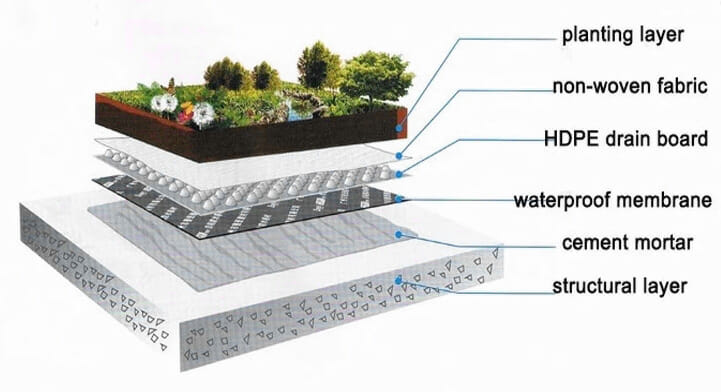
In a plastic drainage sheet, the formed dimples maintain a flow space below the protected layer. Consequently, water can move toward the designed collection points.
A plastic drainage sheet is a lightweight dimpled roll that creates a continuous drainage and protection layer for roofs, landscapes, retaining walls and civil construction.
Dimpled high-density polyethylene rolls replace part of the traditional pebble drainage layer, helping project teams reduce weight, installation time and material handling.

A dimpled drainage sheet uses a formed high-density polyethylene membrane. As a result, the raised dimples create a three-dimensional void with support stiffness, allowing liquid and air to move within the installed layer. In addition, the dimple geometry is designed to resist long-term pressure without losing the required drainage space.
Compared with a loose pebble layer, a plastic drainage sheet in roll format can save installation time, handling effort and roof load. It also combines effectively with filter fabric to create filtration, seepage and drainage functions. For design approval, request load data for the selected LYDS model and confirm the test method, installation orientation and project build-up.
For broader planning context, the U.S. Environmental Protection Agency explains how green infrastructure can manage rainfall where it falls. Therefore, the drainage layer is one component of a complete engineered assembly, so designers must coordinate waterproofing, filtration, outlets, overflow and structural loading.
In a plastic drainage sheet, the formed dimples maintain a flow space below the protected layer. Consequently, water can move toward the designed collection points.
A plastic drainage sheet can reduce the labor and weight associated with traditional granular drainage. Moreover, the material is simple to cut around project details.
Furthermore, the sheet offers chemical resistance, plant-root puncture resistance and a low-maintenance drainage surface when specified correctly.


The LYDS series plastic drainage sheet is available in eight standard dimple heights. Choose a standard roll width of 2 m or 3 m and a standard roll length of 10 m, 15 m or 20 m.
| Model | Dimple height (mm) | Unit weight (g/m²) |
|---|---|---|
| LYDS10 | 10 | 1000 |
| LYDS14 | 14 | 1200 |
| LYDS20 | 20 | 1400 |
| LYDS25 | 25 | 1600 |
| LYDS30 | 30 | 1900 |
| LYDS40 | 40 | 2200 |
| LYDS50 | 50 | 2500 |
| LYDS60 | 60 | 2800 |
| Standard specification | Available options |
|---|---|
| Roll width | 2 m, 3 m |
| Roll length | 10 m, 15 m, 20 m |
| Material | High-density polyethylene (HDPE) |
| Color | Black, White, Blue, Green |
| Package | Bundle |
| Minimum order | One bundle |
For rigid modular drainage and storage cells, compare our drainage board. For modular rooftop planting, review our green roof tray systems.
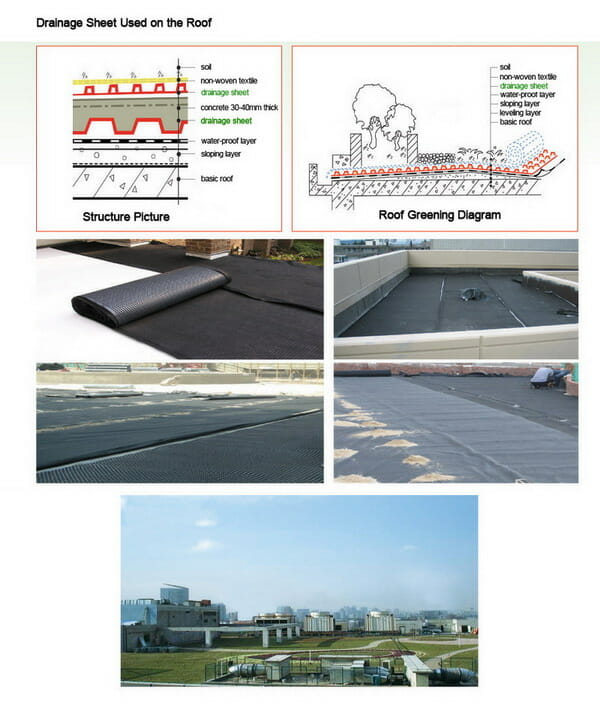
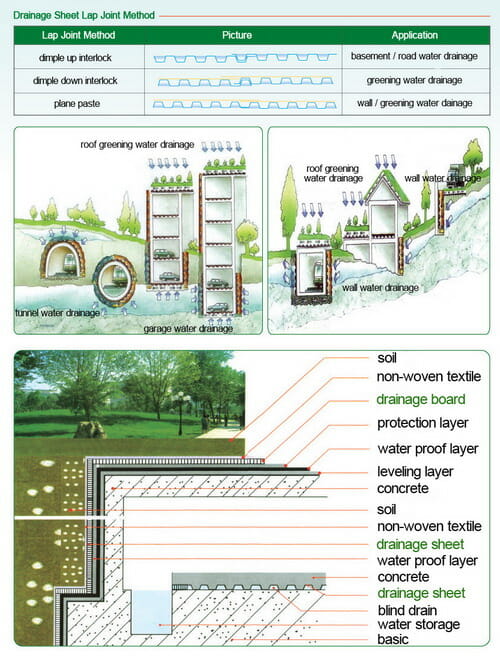
Confirm sheet height, roll size, design load, puncture resistance, flow direction, filter fabric, waterproofing compatibility and outlet spacing.
First, define the application and drainage objective. Next, confirm the design load and sheet orientation. Then, coordinate waterproofing, filter fabric and outlet details. Moreover, request current technical data and packing information. Finally, approve a project-specific sample or specification before procurement. For example, record the selected model and roll size in the purchase order. However, do not rely on general page values where certified data is required. Therefore, keep the approved technical file with the project records. For example, compare the proposed roll with the approved sample. However, treat general website values as preliminary references. Consequently, confirm certified values before contractual approval. In addition, verify roll quantity against the final area. Furthermore, check pallet or bundle dimensions with the logistics team. Moreover, coordinate delivery timing with site access. Similarly, verify membrane and filter fabric compatibility. Meanwhile, reserve allowance for cutting and overlaps. Afterward, issue the approved material schedule. Thus, procurement can compare quotations on the same basis. Finally, archive the supplier response and test documents. In contrast, reject substitutions that lack comparable documentation. As a result, site teams receive a clearly identified product. For this reason, note any approved deviation in writing. In conclusion, release the order only after technical and commercial review.
Send the project location, application, area, target sheet height, loading conditions, delivery port and schedule. As a result, our team can review model selection, quantity, packaging and lead time.
Submit Project DetailsIn short, it is a dimpled high-density polyethylene roll that creates a drainage and protection void behind or below construction layers. Depending on the assembly, it can work with filter fabric to filter soil particles.
It can replace part of a traditional granular drainage layer in suitable designs. However, the project engineer must verify drainage capacity, loading, waterproofing protection and local requirements.
First, compare dimple height, roll dimensions, unit weight, pressure data, puncture strength, flow capacity and installation conditions. Next, request current model-specific test documentation.
Yes, selected sheets can suit roof gardens and podium landscapes when the complete roof assembly meets structural, waterproofing, filtration and drainage requirements.
Related terms: drainage sheet, dimpled high-density polyethylene rolls, drainage plastic sheeting and sheet drainage systems.
Quick project answers
Plastic drainage sheets create a lightweight drainage path within roof, podium, retaining-wall and landscape build-ups. Their role is to move excess water while helping protect adjacent construction layers.
Typical applications include green roofs, podium landscapes, planters, retaining walls and other assemblies where water must move toward a designed outlet.
Important factors include drainage capacity, compressive load, installation orientation, soil or fill depth, filter fabric requirements, waterproofing protection and the intended flow path.
No. It is a drainage and protection component. The waterproofing system, outlets and complete assembly must be designed and installed separately for the project.
We'd love to hear from you. Please fill out the form below.
Enter a product, application or technical topic.