Geocell vs gravel grid is a useful comparison when a landscape path meets sloping ground. Begin with the job the layer must do. A geocell review focuses on confining fill within an expandable cellular system. A gravel grid review focuses on retaining the infill of an interlocking surface. Neither choice, by itself, resolves a slope or drainage problem.
For a path along a planted bank, the walking surface and the adjacent slope may need different solutions. Treat them as connected parts of one landscape, rather than buying one plastic grid for every area. This application study explains how to make that distinction before product selection.

Geocell vs gravel grid: compare the task first
Leiyuan’s geocell ground grid range uses three-dimensional cells to confine aggregate, soil or other specified fill. Its project selection depends on the ground, slope, cell geometry, anchorage and loading. The design team must assess these inputs together.
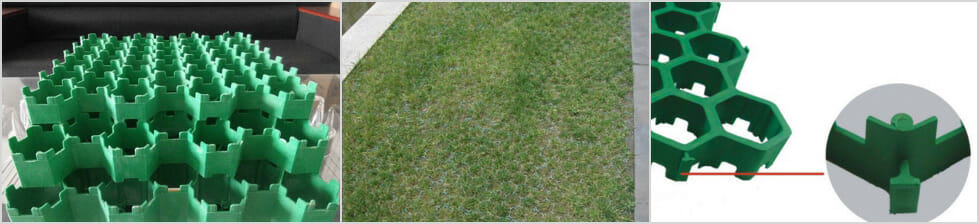
The gravel reinforcement grid range uses interlocking panels for gravel or planted surface construction. The product route includes landscape paths, access areas and suitable parking applications. However, a panel connection is not proof that a finished surface will resist movement on every incline.
These are starting points for a proposal. They are not universal approval rules. Ask what movement the designer needs to control, where water will travel and what the finished surface must support. Then identify the product configuration that can be reviewed against that brief.
Separate the bank from the route beside it
Consider an illustrative garden path that runs along the foot of a planted bank. The bank needs an erosion and ground-stability review. The path needs a usable walking surface, defined edges and a coordinated base. Water arriving from above also needs a planned route.
On the bank, a cellular confinement proposal may form part of the designed slope treatment. Yet geocell cannot substitute for a ground investigation or solve a deeper slope failure simply because it holds surface fill. Anchorage, connections and the crest and toe details belong in the project design.
Along the path, the team may compare an interlocking gravel finish with another suitable paving option. The decision concerns the full walking experience as well as gravel retention. Review wheelchairs, pushchairs, maintenance trolleys and the expected surface use. Do not assume that visible cells or a gravel colour establish access suitability.
Read the water path before the product pattern
Water can approach from the bank, pass through the surface or run along the path. Those movements create different demands. A surface that accepts rain locally may still receive concentrated runoff from an uphill area.
First, identify the catchment and the intended drainage route. Next, coordinate the infill, base, subgrade and any designed outlet. Keep soil from adjacent planting areas from becoming an unplanned source of sediment on the finished path.
The U.S. EPA overview of green infrastructure describes permeable pavements within a wider water-management approach. In this application, permeability still depends on the whole build-up. Open cells at the top are not evidence that the ground below can accept all incoming water.
Geocell vs gravel grid: compare the complete build-up
A geocell vs gravel grid proposal becomes more useful when both options describe the same site and use. Compare the supplied component alongside the layers, boundaries and work needed around it.
| Question | What the comparison should show |
|---|---|
| What is being restrained? | Surface gravel movement, fill within a slope treatment, or another clearly defined task. |
| What supports the layer? | Actual ground conditions and the proposed base, rather than an isolated product load figure. |
| What holds the system in position? | Connections, edge restraint and any anchorage specified for the application. |
| How is the finish maintained? | Infill condition, sediment control, access and inspection of the designed drainage route. |
Finally, compare geocell vs gravel grid costs using the full scope. A small path surface and a broad bank treatment do not become equivalent merely because both prices use square metres. State what each quotation includes before comparing totals. Keep earthworks, base preparation and specialist installation scope visible.
Review the transition as its own detail
The junction between bank and path deserves particular attention. Show the finished levels, the boundary of the cellular system and the intended runoff route. Resolve how aggregate, planting soil and the next surface meet.
A neat visible border is only one part of that junction. The edge also needs to work with the support and restraint specified for the system. A decorative garden edge should not be assumed to provide the anchorage or structural restraint required elsewhere in the detail.
Turn the comparison into a project enquiry
For a geocell vs gravel grid review, send a plan and section showing the path, adjacent bank and drainage direction. Include the intended users, ground information, proposed infill and the area of each treatment. State whether maintenance vehicles will enter the route.
Use the existing Leiyuan Greening Solution project enquiry page to discuss the relevant product route. Leiyuan supplies products and product information; the project’s qualified professionals should confirm the final ground, drainage and installation design. A useful selection starts by assigning each layer a clear task and reviewing the transitions between them.