Stable surface geometry
Honeycomb or mesh cells distribute aggregate and help maintain a defined surface. In addition, the interlocking connection keeps adjoining panels aligned during installation.
A gravel reinforcement grid gives commercial landscape and civil projects a stable cellular base for gravel, grass and permeable surface construction.
A gravel reinforcement grid is an interlocking HDPE system that stabilizes gravel or grass while supporting traffic, drainage and a cleaner finished surface.
Our ground reinforcement and grass reinforcement products use an interlocking format to divide the finished surface into stable cells. Consequently, the system helps limit gravel movement, rutting and local soil erosion while keeping the visual character of gravel or planted ground.
Gravel grids are widely specified for parking spaces and driveways. They use reprocessed high-density polyethylene and can also suit dry or hot regions. Published product data lists grass coverage of up to 95% and load performance of up to 200 tonnes per square metre for selected configurations. Because project conditions vary, buyers should confirm the chosen model, base build-up and design load with our team before specification.
For broader stormwater context, the U.S. Environmental Protection Agency explains how green infrastructure can manage rainfall where it falls. A permeable reinforced surface can form one project component, subject to local engineering and drainage requirements.
Honeycomb or mesh cells distribute aggregate and help maintain a defined surface. In addition, the interlocking connection keeps adjoining panels aligned during installation.
Panels can be shaped into arcs or other site geometries with standard cutting tools. Borders or fixing pins can also help manage edges and thermal movement.
Different thicknesses and mesh configurations support varying applications. Therefore, the most suitable model depends on traffic, subgrade, fill, planting and maintenance requirements.
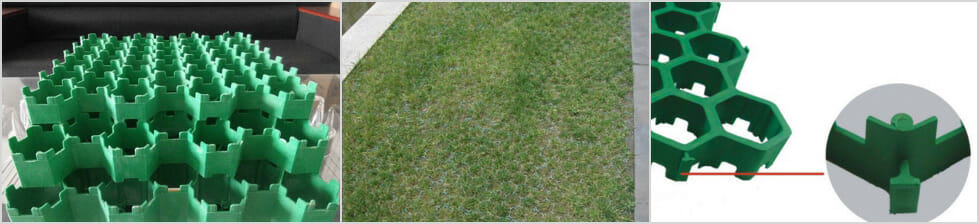
Standard models share a 465 × 535 × 50 mm panel size, while the LY950 format measures 333 × 333 × 50 mm. Please send the project area, loading class and planned infill so we can recommend a suitable product and packing plan.
 MZ-450465 × 535 × 50 mm
 MZ-438465 × 535 × 50 mm
 MW-450465 × 535 × 50 mm
 MW-438465 × 535 × 50 mm
 LY950333 × 333 × 50 mm
For sites dominated by concentrated loads or slope control, compare our geocell ground grid. For equestrian applications, review the dedicated horse paddock grid system.
Residential roads often border green belts, while lawns sit close to the street. Without suitable construction and maintenance, the soil may compact. A cellular reinforcement system offers a practical way to integrate traffic use with planted or aggregate surfaces.
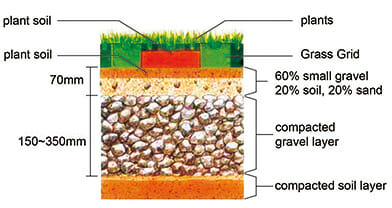
First, prepare and compact the subgrade to the project engineer’s requirements. Next, install the specified drainage and base layers. Then place the panels, leave an appropriate movement gap where required, add the selected infill and complete the final surface. A typical spacing allowance is 10–15 mm between panels, although the project detail should govern.
These build-ups preserve the original application guidance but are illustrative. Final layer thickness, drainage design, edge restraint and load verification remain the responsibility of the project engineer.
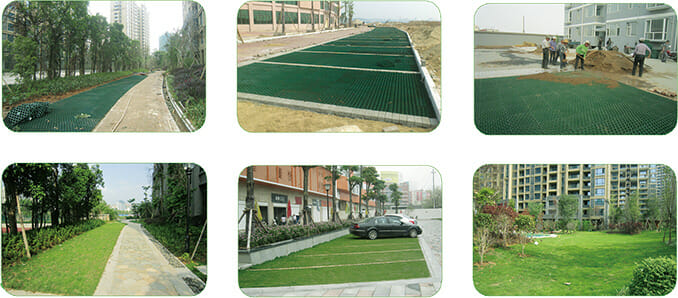

Fix the lawn border or use fastening pins where the design requires additional edge control. Moreover, confirm expansion allowance, panel orientation and base compaction before filling the cells.

For an efficient recommendation, please share the following project information:
With these details, our team can review model selection, quantities, packaging and lead time for your RFQ.
It is a cellular plastic panel installed over a prepared base and filled with gravel, soil or planting media. The cells retain the infill and help distribute surface loads.
Yes, selected models suit parking bays and driveways when the complete build-up is designed for the expected traffic. Confirm the base, load class, infill and edge restraint before ordering.
The open-cell system can support a permeable build-up. However, actual drainage depends on the infill, bedding, subbase, soil infiltration and outlet design.
Start with the application, area, design load, subgrade, intended fill and local drainage requirements. We can then compare available panel sizes and configurations for procurement.
Quick project answers
Plastic gravel grids confine loose aggregate, spread surface loads and help maintain a permeable, more stable finish. They are commonly considered for landscape access, parking and pedestrian areas.
It reduces gravel migration, rutting and local displacement while helping distribute loads and preserve a more even permeable surface.
They can be used in suitable traffic applications when the grid, base course, subgrade preparation, edge restraint and aggregate are designed for the expected vehicles and frequency.
No. Long-term performance depends heavily on subgrade strength, drainage, base thickness, compaction, edge restraint and correct aggregate selection.
We'd love to hear from you. Please fill out the form below.
Enter a product, application or technical topic.