Horse paddock gateways need more than a firm strip directly beneath the gate. Horses pause while a latch opens, turn toward a track and gather near the fence. People and wheelbarrows often follow a slightly different line. A useful improvement therefore covers the approach, the waiting space and the transition back to the paddock.
This application study explains how to plan that whole area before choosing a grid system. It is a design scenario, rather than a report of a completed Greening Solution project. The aim is to match ground reinforcement to daily movement and local drainage conditions.
Why horse paddock gateways need a wider view
Imagine a gate between a grass paddock and a shared access track. The ground inside the opening looks worst, so the initial proposal is a small rectangle of reinforced surfacing. However, horses wait just outside that rectangle. The handler turns beside the hinge post, while the wheelbarrow cuts across its corner.
The small patch may improve one spot yet leave those adjacent routes untreated. Its edge then becomes part of the daily traffic line. Rather than choosing an arbitrary rectangle, watch how the entrance works during turnout, feeding and cleaning. Mark the places where animals stop, where handlers stand and where traffic changes direction.
That observation turns a vague request for “less mud” into a useful design brief. It also distinguishes a gateway from an arena: the task is to support concentrated access and repeated turns, not to specify an entire riding surface.
Water management at horse paddock gateways
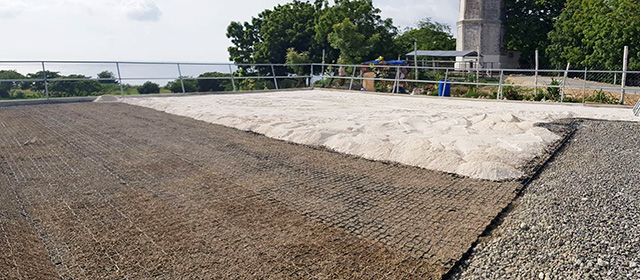
At horse paddock gateways, a grid selection cannot resolve every source of wet ground. First distinguish rain falling on the entrance from water arriving from a roof, an uphill track or an adjacent yard. A surface that appears acceptable in dry weather can receive a very different flow during a storm.
The University of Minnesota Extension’s guidance on managing mud on horse farms, reviewed in 2024, identifies gates and laneways as high-traffic areas. It discusses facility layout, drainage, roof-water management and layered heavy-use pads. It also advises following manufacturers’ instructions when alternative grid products are used.
Apply that distinction to the entrance plan. Show where water comes from and where it can go safely. If the outlet or ground conditions remain unclear, resolve them with the appropriate local designer before finalizing the construction. Do not treat the open cells of a product as proof that the underlying soil will absorb all incoming water.
Match the reinforced area to three everyday movements
| Movement | What to observe | Design implication |
|---|---|---|
| Waiting at the gate | Where horses gather while the gate is closed | Include the actual standing area in the brief |
| Turning through the opening | The handler’s position and the normal turn toward the track | Avoid ending the improved surface at a heavily used corner |
| Cleaning and daily access | Wheelbarrow routes, gate swing and access to the latch | Coordinate the surface boundary with practical maintenance |
These observations do not establish a universal pad size. A quiet single-horse entrance and a busy shared gateway can need different layouts. The useful result is a measured sketch of the particular space, supported by photographs after rain.
Where interlocking paddock grids fit
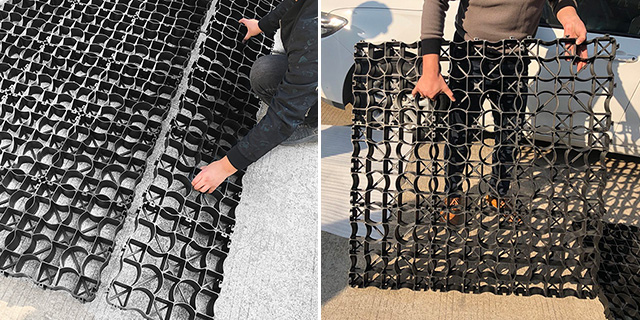
Greening Solution’s horse paddock grids provide an interlocking cellular layer for ground reinforcement. The current product page lists HDPE grid options and describes applications including gateways, stable approaches and tracks. Their role belongs within a complete build-up that also addresses the supporting ground, fill and drainage.
When improving horse paddock gateways, the key discussion is how the chosen grid, base and surface material work together at this particular entrance. Request installation details for the selected product and intended use. Avoid borrowing a layer thickness from a different site or assuming that a general product load figure proves the capacity of the finished ground.
Plan the edges of horse paddock gateways
The transition from reinforced ground to an existing track or grass deserves attention. A neat product layout on paper is less useful if its edge falls exactly where traffic turns or water collects. Discuss finished levels, edge support and the connection to neighboring surfaces as part of the same proposal.
Consider maintenance access at the same time. The latch, hinge area and full gate swing should remain usable after the final surface is installed. There should also be a practical route for removing manure and replenishing suitable surface material. A grid system is a maintained surface, not a promise of permanently maintenance-free ground.
Turn the entrance survey into a useful inquiry
For horse paddock gateways, a useful inquiry includes the opening width, daily traffic pattern, current surface, observed wet areas and any proposed changes to nearby drainage. Add a simple plan showing the waiting and turning areas, rather than sending only the gate’s width and length.
With that information, product selection becomes a conversation about a workable entrance. Contact Greening Solution to discuss suitable grid options and the installation information needed for your site. Confirm the ground preparation and drainage design locally before placing the final order.