What is the role of a geocellular unit?
The unit creates structural void space for temporary stormwater storage. The surrounding geotextile or membrane determines whether the completed system infiltrates, attenuates or stores water.
Geocellular infiltration units provide modular underground capacity for stormwater infiltration, temporary storage, and controlled release in engineered drainage projects.
Geocellular infiltration units create modular underground voids for stormwater storage, controlled drainage, and site-specific infiltration.
For wider sustainable drainage context, refer to the U.S. EPA green infrastructure guidance.

Size: 2.23’ x 1.35’ x 1.48’ (680 x 410 x 450mm)
Material: 100% Recycled PP, or Virgin Materials
Load Capacity: 35T/m2
Tanks: 8 tanks/cbm
Void ratio: 95%
Water Storage: 120L/tank
Weight: 8kg/tank
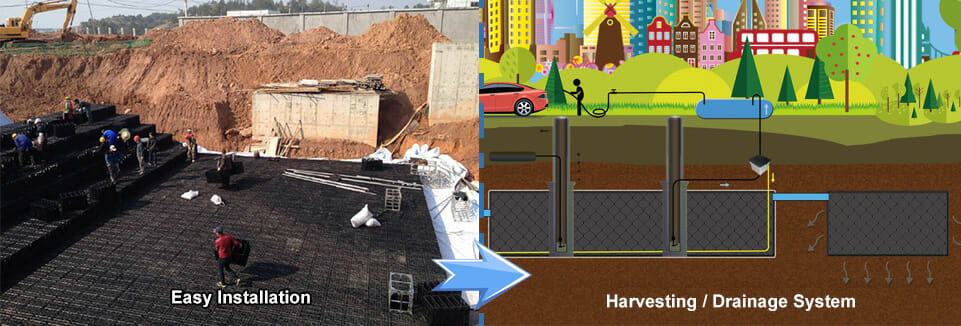
The M2014 Modular Geocellular Box Units are designed to provide efficient stormwater management through retention, attenuation, and infiltration. These units are essential for modern urban drainage systems, offering a flexible and sustainable solution for water management.
We are a professional manufacturer from China, offering OEM services with a focus on quality and customer satisfaction.
Rainwater Retention, Attenuation and Infiltration
The Stormwater Drainage Tanks can be mainly used for rainwater Retention, Attenuation, Infiltration. The drainage system and water storage-permeation and filtration system along side the roads, parking lot, water storage and drainage for the ecological shallow ridges, living community, factories and enterprises, municipal roads, viaducts and bridges, park and scenic spot, it will be the necessity for construction of sponge city.
Space saving: With underground installation, the system will not occupy valuable subaerial space.
Lower Cost: Less costly than concrete and metal storage systems.
Maximum Storage Capacity: Modular units allow flexibility of shape, ideal for narrow strips or restricted areas.
Construted Rapidly: Intallation construction simplified and minimize the construction period.
No Later Maintenance: Barely no post-maintenance after installation.
Recycling process flow diagram
Rainwater pipe -- drainage pipe -- rainwater flow & filtration unit -- automatic filter -- storage modules -- disinfection treatment -- water consuming point
Notes to process flow diagram: upon multiple pretreatment steps taken on initial rainwater, it could ensure the quality of the harvested rainwater. Rainwater storage modules are used to store rainwater, which ensures the water quality, small occupied space, easy and convenient installation and also makes it more environmental-friendly and safer. With pressure control pump and rainwater controller, rainwater can be easily delivered to water consuming point. Besides, rainwater controller also could show the water level of Modular Geocellular Tank Units in real time, so as to reach the water consuming point.
Advanced stormwater management solutions like the M2014 Modular Geocellular Box Units are essential for modern urban infrastructure. These geocellular storage crates offer robust, efficient, and sustainable stormwater management, ensuring cities can better handle the challenges of climate change and urbanization. Contact us today to learn more about how our Modular Geocellular Units can benefit your project.
Finally, engineers can configure geocellular infiltration units around site loading, storage volume, and discharge requirements to create a practical system for resilient drainage design.
Related words
Modular Geocellular Units
Stormwater Drainage Tanks
Geocellular Infiltration Tank Units
Geocellular Water Box Management System
Rainwater Drainage System
Quick project answers
Geocellular units provide high-void underground storage for infiltration and drainage projects. Their modular format allows the storage footprint and depth to be arranged around site constraints.
The unit creates structural void space for temporary stormwater storage. The surrounding geotextile or membrane determines whether the completed system infiltrates, attenuates or stores water.
Required volume, depth, surface loading, groundwater, soil conditions, access, installation method and the project engineer’s structural and hydraulic criteria are important.
We'd love to hear from you. Please fill out the form below.
Enter a product, application or technical topic.